

Hello, everyone!
In the previous articles, we provided an overview of Unified Architecture Framework (UAF) and delved into its Domain Metamodel. With this post, we’ll explore the “viewpoints” defined in UAF, starting with a dive into the Strategic Viewpoint, a central element in the UAF viewpoints.
 Strategic Viewpoint
The Strategic Viewpoint – True to its name, the Strategic Viewpoint involves high-level strategic considerations within the context of enterprise architecture. But what exactly do we mean by ‘strategy’? In UAF, strategy is constructed around ‘capabilities’ a concept we introduced in our last article. The Strategic Viewpoint encompasses various view specifications, each represented as a cell within the UAF Grid (Please refer to Unified Architecture Framework (UAF) Domain Metamodel, v1.2 – 7. UAF Grid – Figure 7:1- UAF Grid) . These include:
- Strategic Motivation
- Strategic Taxonomy
- Strategic Structure
- Strategic Connectivity
- Strategic Process
- Strategic States
- Strategic Information
- Strategic Roadmap
- Strategic Traceability
Strategic Structure
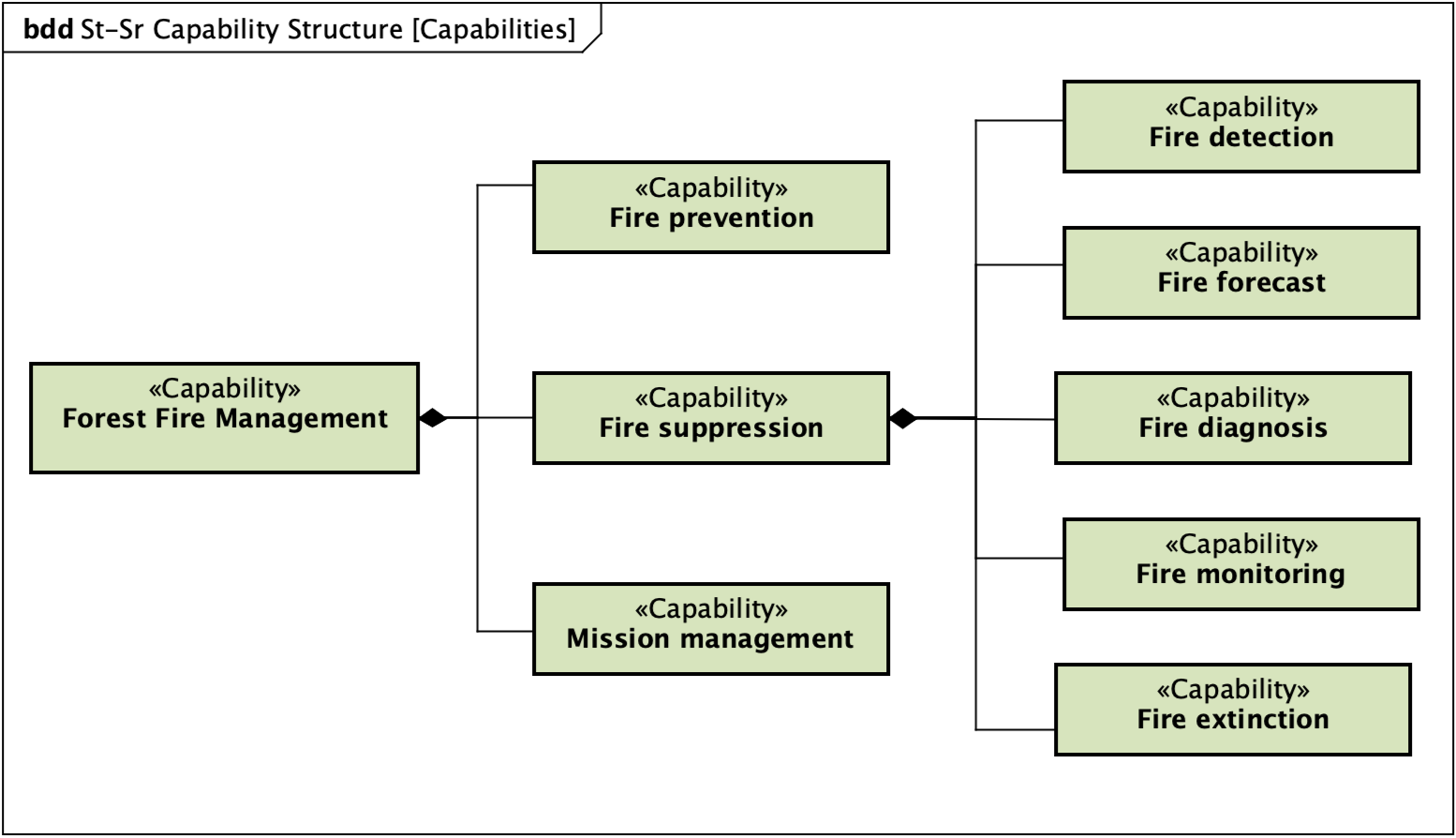
For instance, the model diagram showing the composition of capabilities that we introduced in the last post falls under Strategic Structure.
Then what do the other view specifications describe?
Strategic Taxonomy
Strategic Taxonomy – This aspect involves defining the vocabulary of capabilities.

In our example, each Capability’s explanation is provided using notes (in pink rectangle), although such detailed explanations are optional if the Capabilities are already adequately described.
You might find separating structure and taxonomy cumbersome, but they serve distinct yet complementary purposes. Strategic Taxonomy focuses on understanding what capabilities exist, while Strategic Structure addresses how these capabilities are hierarchically organized. Despite using similar models in two Block Definition Diagrams, the focal points differ. These view specifications assist in creating models that accurately and appropriately represent concepts, without express or deficiency.
Strategic Motivation
Strategic Motivation – Here, the background and rationale for deriving capabilities are defined.
In UAF, concepts like Driver, Challenge, and Opportunity are outlined along with their interrelationships. These concepts, prevalent in enterprise systems engineering, help model the context behind the derivation of capabilities. For example, in hypothetical forest fire management system, this can be articulated as follows.

A ‘Driver’ is a factor that necessitates the creation of the enterprise system. A ‘Challenge’ is a problem that needs to be solved, considering those factors. An ‘Opportunity’, then, is an element that contributes to solving those challenges. Understanding these concepts and their relationship with capabilities helps in assessing the validity of the capabilities.
For instance, in the above example, the frequent occurrence of national forest fires is depicted as a Driver for creating the enterprise system, with the Challenge being the initiation of response measures as early as possible. Recording consensus on these challenges is important, even as we set aside the validity of this specific model for now.
Additionally, opportunities contributing to solving this challenge, like rapid firefighting activities, are noted. Next, we explore the model describing the relationship between these motivations and capabilities.
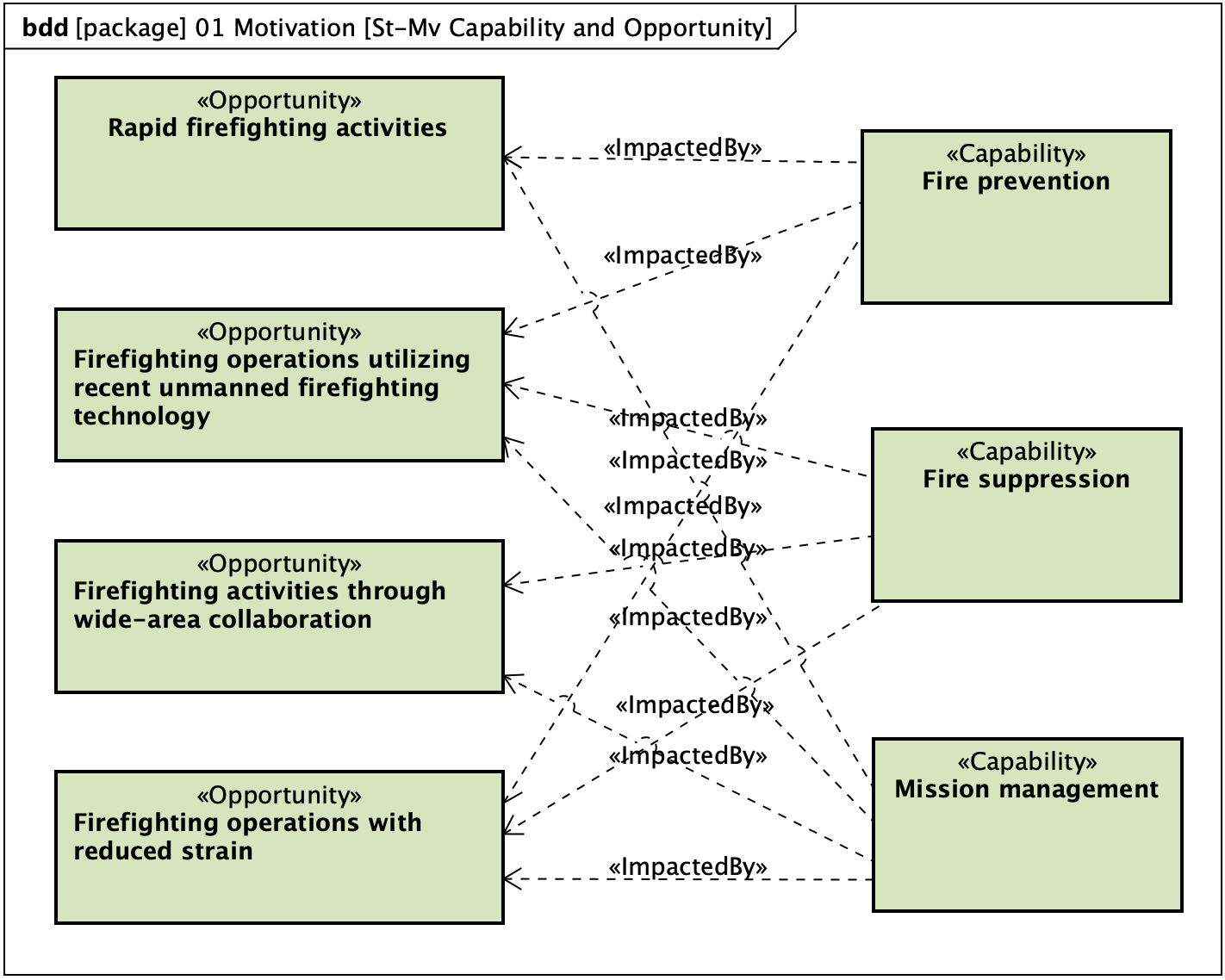
Here, the Opportunities and their relationships with capabilities are described. Such documentation helps in examining the necessity and sufficiency of the capabilities.
The Importance of the Strategic View
As shown above, the Strategic View includes numerous view specifications. Enterprise Architecture requires many perspectives for accurate description, and UAF ensures clarity by allowing distinct descriptions for each specification. By defining and designing the enterprise architecture using UAF and its view specifications, your team gains comprehensive insight, ensuring all members are equally informed and reducing reliance on specific individuals for architectural knowledge.
Interested in UAF?
All the SysML Block Definition Diagrams in this blog post are produced using Astah System Safety You can try out this product for 40 days for free if you’re interested.

Download UAF Plug-in
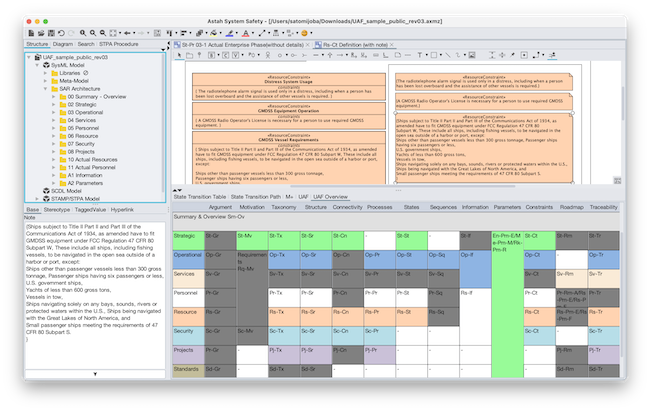
UAF Plug-in was released on March 12th, 2024. This complimentary plug-in works for both Astah SysML and Astah System Safety. Feel free to give it a try!
Stay tuned for the next post!
Cheers,
Astah Team
 Astah in 5min
One thought on “A 5-minute Introduction to UAF (Unified Architecture Framework): Strategic View”